
Long Island Sound Seaweeds
If you’ve ever walked along the beach, you’ve probably seen a few green or brown, slimy clumps without giving them much thought. But that slimy stuff is far more fascinating than it looks at first glance. It’s part of a huge and diverse group of organisms known as macroalgae, or more commonly, seaweed!
There are thousands of different types of seaweed you can find all over the world. You will find many of them close to the surface of the water because they are photosynthesizers, which means they need sunlight to survive. Some species are free floaters that travel through the water column as microscopic phytoplankton. Others grow into underwater forests that tower from the seafloor and create entire marine ecosystems, such as giant kelp (NOAA 2024).
Long Island Sound has many different species of seaweed that may be attached to substrates on the seafloor or attached to rocks along the coastline. There are around 250 different species of seaweed found here (Patten 2009). These plants play a crucial role in keeping the Sound healthy; they produce oxygen, offer shelter to marine creatures, and, some believe it or not, are a food source for us.
Most of the Sound’s macroalgae anchor themselves to rocks, shells, and other hard surfaces. Seaweed mainly appears in green, red, and brown colors (Lynch 2017), and many thrive in the Rocky Intertidal Zone, which is a habitat that’s underwater for about half the day due to tidal influence.
Some of the most familiar species include sea lettuce, green fleece, rockweed, and knotted wrack. You can find these along the sandy beaches and draped over rocks, docks, and hard substrates along the coast. Here are some fun facts about the different types of seaweed you can find on Long Island Sounds coast!
- Sea Lettuce – As its name suggests, this bright green seaweed looks like leafy salad greens. It usually attaches to rocks and shells, but you’ll often see it drifting freely in the water as well (Maine Coast Sea Vegetables).
- Green Fleece – Also known by the name “Dead Man’s Fingers” this species has spongy, bright green, finger-like branches. Though it originated in Asia, it has now spread across much of the world (NYS Department of Environmental Conservation).
- Irish Moss – A small but sturdy red seaweed that grows in the mid to low intertidal zone. Its low profile helps it withstand the powerful waves and currents that sweep the shoreline.
- Sugar Kelp – A brown colored seaweed that grows in cold waters of Long Island Sound. They can grow as long as 12 meters. They have the ecological benefit of removing excess nitrogen and carbon from the water. They are also an important part of the aquaculture industry.
- Rockweed – A brown seaweed with circular branches that are a yellowish-brown with a rougher texture. Rockweed can provide a cover along the shoreline for many organisms, especially during low tide.
- Knotted Wrack – A very large brown seaweed that is found in the northern Atlantic Ocean. It anchors itself to rocks and can live for decades. This makes it a vital habitat and food source for many different species.
These are just a few of the many species of seaweed that call Long Island Sound home. Each one plays an important part in supporting the fish, invertebrates, and other organisms that depend on this ecosystem.
So next time you’re walking along the beach, and you spot a patch of seaweed, pause for a moment. You might be surprised by what you can identify!

Rockweed

Knotted Wrack
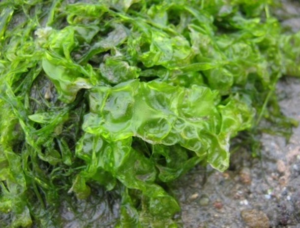
Sea Lettuce

Green Fleece

Irish Moss
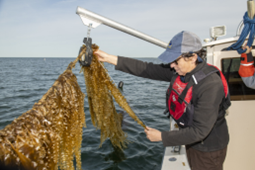
Sugar Kelp
Citations:
https://oceanservice.noaa.gov/facts/seaweed.html
https://dec.ny.gov/nature/animals-fish-plants/green-fleece
https://extension.umaine.edu/signs-of-the-seasons/indicator-species/rockweed-fact-sheet/\


