
** Reserve Now for Fall 2027 **
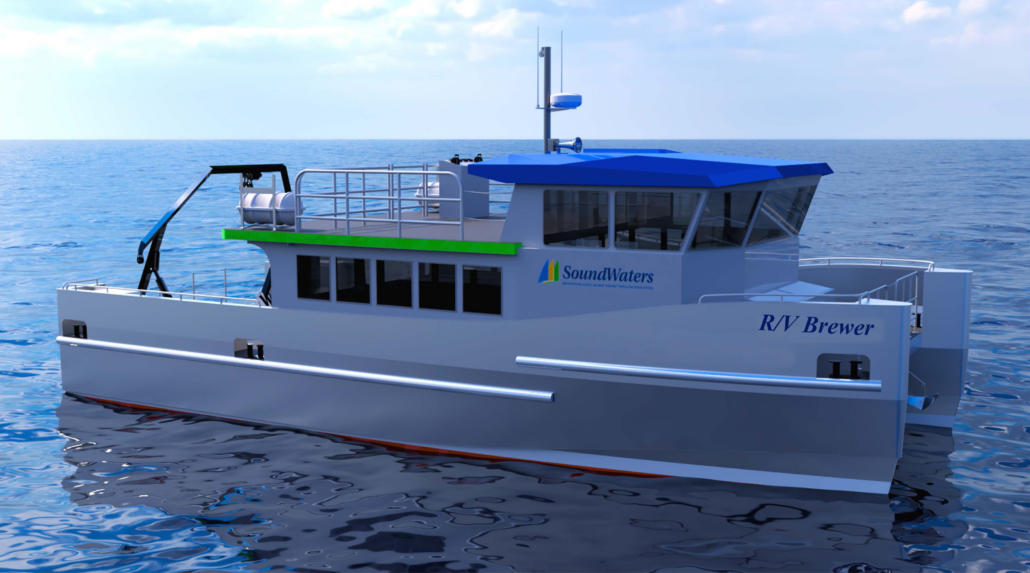
Your Students Can Explore Long Island Sound on the new R/V Brewer
Long Island Sound is the Best Classroom
SoundWaters new research vessel, the R/V Brewer, will turn Long Island Sound into a fascinating million-acre classroom for your students. Using sophisticated equipment, they will test the waters of Long Island Sound, haul in a trawl net full of different amazing animals and begin to make their own observations and conclusions about the health of our greatest natural resource.
Accommodating up to 30 passengers, the R/V Brewer features multiple teaching spaces, including an on-board lab. Your students will be divided into smaller groups and rotate through a series of activities to facilitate an authentic, hands-on research experience for each student.
We’ll Come to you. The R/V Brewer is designed to access Long Island Sound coastal communities. If yours is a coastal community, we’ll bring the boat to you. If you are inland, we will find a coastal community near you and the R/V Brewer will meet you there. Our goal is to get your students onto the water.
Safety and Education: Three Decades Teaching on the Water
SoundWaters has been teaching students – over 300,000 of them – on boats on Long Island Sound for over three decades. Our full-time, professional education team will inspire your students with a hands-on marine science experience they will remember for years. Our U.S. Coast Guard-licensed captain and crew will ensure your students are comfortable and safe aboard the Coast Guard-certified R/V Brewer.

What Do Teachers Think?
“Our students are deeply engaged in the study of marine sciences, and SoundWaters is our ultimate pathway to researching the Long Island Sound. This new floating laboratory will provide an incredible hands-on experience for them and, I believe, will make our marine science program even more appealing.”

“SoundWaters has been our environmental science partner for decades. From elementary through AP Environmental Science, our teachers build their curriculum around our field study with your education team. Getting our students out of the classroom for real-life experiences on the Sound creates powerful learning for our students.”

“I have been impressed by how my students – from core level to AP– all get excited by getting out of the classroom and learning on Long Island Sound. Whether it’s on the Schooner or at the Harbor Center, they are doing science they’ve never tried before and they’re enjoying it.”
“Our students come to SoundWaters with different experiences and ways of engaging with learning, and hands-on learning outdoors is a great leveler. They all test water samples, they all use microscopes, they all hold marine animals—and because it is new, real, and tangible, every student has an opportunity to connect and be curious.”

Science on the Sound
A comprehensive introduction to oceanography, biology, and human impact.
This program gives students foundational concepts in marine science, biology, chemistry, and human impacts on environmental systems. Students will help deploy sampling gear, including benthic and manta trawl nets. They will learn about Long Island Sound’s population dynamics and community structures firsthand by examining species in the lab under a microscope and as they are brought aboard in the trawl net. Students will also gain appreciation for our connection to the ecosystem as we work together to sample water at depth using a CTD rosette sampler. Using hands-on tools, students will test water-quality parameters and infer how human activity affects the Sound’s ecosystems. Together, these hands-on investigations give students a deeper understanding of Long Island Sound as a dynamic, connected ecosystem and their role in its future.
ACTIVITIES
Overview of Activities:
Trawling
Students will conduct trawls aboard the R/V Brewer to count and measure animals that come aboard. The unique relationships of animals in Long Island Sound to climate change, thermal tolerance, and redistribution will be discussed. Students can perform fish tagging while on board to deepen the learning and value of the trawl. The tagging and monitoring protocol will be discussed to deepen understanding of conservation principles.
Plankton Analysis
Students will conduct plankton analysis aboard R/V Brewer. A manta trawl net will be towed behind the boat, capturing samples that students will then analyze. If we use handheld plankton nets for a more interactive experience, students will lower these small nets over the R/V railing. The samples will be brought into the wet lab and students will observe and identify plankton captured in the net, discovering which species of phyto- and zoo-plankton are observed in the surface waters of Long Island Sound, and in what abundance. Students will also visualize plankton using a larger screen connected to a microscope.
Water Quality Analysis and Human Impact
Students will help deploy a 6-bottle rosette sampler. This type of array models real in-field and on-board scientific research. Students will see temperature and conductivity gradients in real time. Students will conduct several tests, including temperature, salinity, CO2, NO3, and turbidity. Students will gain an understanding of different water quality parameters and how these parameters come together to create a clearer picture for environmental monitoring.
NGSS ALIGNMENT
SCHEDULE
PRICING
NEXT STEPS
“Our students come to SoundWaters with different experiences and ways of engaging with learning, and hands-on learning outdoors is a great leveler. They all test water samples, they all use microscopes, they all hold marine animals—and because it is new, real, and tangible, every student has an opportunity to connect and be curious.” – Heather Chila, High School Asst. Principal, Great Oaks Bridgeport, CT
Biology of the Sound
Designed for AP Biology Curriculum; adaptable for any course level.
This research experience aboard the R/V Brewer brings biology into the field, allowing students to apply concepts to organisms and ecosystems in Long Island Sound. Through hands-on surveys of benthic communities using a trawl net, students investigate marine biodiversity and examine how evolutionary history and morphological adaptations are reflected across the major animal phyla found in the Sound. Students will connect observations of living organisms to concepts of phylogeny, evolution, and structure-function relationships.
Students will also investigate Long Island Sound’s microscopic communities through plankton sampling and microscopy. By comparing plankton communities across sampling locations and environmental conditions, students will explore population dynamics, community structure, and how abiotic factors influence biological populations.
Finally, students will collect and identify benthic macroinvertebrates from sediment samples, using dichotomous keys to assess community composition and biodiversity. Students will use the organisms present as biological indicators to evaluate ecological health, applying concepts of species tolerance, biodiversity, and ecosystem function to assess environmental conditions.
Throughout the experience, students engage in authentic field-based research while developing skills in biological identification, microscopy, quantitative data collection, ecological assessment, and scientific analysis.
ACTIVITIES
Overview of Activities:
Benthic Trawl
Students will conduct trawls aboard the R/V Brewer to count and measure animals that come aboard. Students will discuss how climate change, thermal tolerance, and population redistribution affect animals in Long Island Sound. Students can perform fish tagging while on board to deepen the learning and value of the trawl. The team will discuss the tagging and monitoring protocol to deepen understanding of conservation principles.
Plankton Sampling
Students will conduct plankton analysis aboard the R/V Brewer. A manta trawl net will be towed behind the boat, capturing samples that students will then analyze. If we use handheld plankton nets for a more interactive experience, students will lower these small nets over the R/V railing. Students will bring the samples into the wet lab, observe and identify the plankton captured in the net, and determine which species of phytoplankton and zooplankton are present in the surface waters of Long Island Sound and in what abundance. Students will also visualize plankton using a larger screen connected to a microscope.
Sediment Macroinvertebrates
To model the true scientific experience aboard a research vessel, R/V Brewer will be equipped with robust benthic sediment grab equipment (Ponar/Van Veen/Peterson), which students will help educators lower to the bottom of Long Island Sound. The sediment is sieved, and striations of various layers are noted. Students will remove organisms living in the sediment, gaining skills in species identification.
NGSS ALIGNMENT
AP ALIGNMENT
SCHEDULE
PRICING
NEXT STEPS
“Our students are deeply engaged in the study of marine sciences, and SoundWaters is our ultimate pathway to researching the Long Island Sound. This new floating laboratory will provide an incredible hands-on experience for them and, I believe, will make our marine science program even more appealing.”
– Eva Bartush, Marine Science Academy Coordinator, Brien McMahon High School, Norwalk CT
The Connected Sound
Designed for AP Environmental Science Curriculum, adaptable for any course level
Through hands-on determination of environmental conditions and marine populations, students will connect local observations to global patterns. Students will help deploy a benthic trawl net and learn to differentiate between cold-water- and warm-water-preferring species, identify which species are new additions to the Long Island Sound ecosystem due to warming waters, and determine which are threatened by climate change. While learning to identify plankton species, students will analyze microplastic particles captured concurrently in the manta trawl with microscopic organisms. After assessing weather conditions and water quality, students will compare their observations with global trends in weather and climate data. This program will introduce students to the complex interactions between the Long Island Sound ecosystem and the communities that make up its watershed.
ACTIVITIES
Overview of Activities:
Animals & Climate – Benthic Animal Community Survey
Students will conduct trawls aboard the R/V to count and measure animals that come aboard. We will discuss the unique relationships between Long Island Sound animals and climate change, thermal tolerance, and redistribution. Students can perform fish tagging while on board to deepen the learning and value of the trawl. The tagging and monitoring protocol will be discussed to deepen understanding of conservation principles.
Plankton & Microplastic Dual Analysis – Assessing Life & Pollution in the Water Column
Students will engage in a hands-on dual analysis activity using a manta trawl net to study both plankton and microplastics in the surface waters of Long Island Sound. Students will observe, identify, and quantify phyto- and zooplankton species using a microscope connected to a larger screen. Students will process the same samples to capture and quantify microplastics, providing insights into marine biodiversity and environmental pollution.
Water Quality Monitoring
Students will help deploy a 6-bottle rosette sampler. This type of array models real in-field and on-board scientific research. Students will see temperature and conductivity gradients in real time. Students will conduct several tests, including temperature, salinity, CO2, NO3, and turbidity. Students will gain an understanding of different water quality parameters and how these parameters come together to create a clearer picture for environmental monitoring.
NGSS ALIGNMENT
AP ALIGNMENT
SCHEDULE
PRICING
NEXT STEPS
“SoundWaters has been our environmental science partner for decades. From elementary through AP Environmental Science, our teachers build their curriculum around our field study with your education team. Getting our students out of the classroom for real-life experiences on the Sound creates powerful learning for our students.”
– Rob de Andrade, Assistant Director of Curriculum, Instruction, and Assessment Supervisor of STEM, Stamford Public Schools
Oceanography on the Sound
A deep dive into marine systems.
An immersive oceanography experience where students use scientific equipment to investigate how Long Island Sound functions as an interconnected system. This oceanography cruise brings biology, physics, and chemistry together to understand how Long Island Sound functions and how it is changing over time. Throughout the trip, students will use scientific equipment and research techniques to investigate life in the Sound, the seafloor, and changing water conditions.
Students will conduct a marine species assessment using a trawl net, collecting, identifying, and recording marine organisms while learning about the diversity and distribution of life in Long Island Sound. Using a towfish, students will map the seafloor and investigate an area many have never seen. Students will also deploy a rosette to collect water samples at varying depths and test temperature, conductivity, pH, and salinity, connecting these findings to climate and environmental change.
By collecting and analyzing data from different aspects of Long Island Sound, students experience how oceanographers study multiple themes to understand the complexities that affect a marine ecosystem.
ACTIVITIES
Overview of Activities:
Climate and Water Analysis
Students will help deploy a 6-bottle rosette sampler. This type of array models real in-field and on-board scientific research. Students will be able to see the gradients of temperature and conductivity in real time. Several tests, including temperature, salinity, CO2, NO3, and Turbidity testing, will be conducted. Students will gain an understanding of different water quality parameters and how these parameters come together to create a clearer picture for environmental monitoring.
Seafloor Mapping
Students will use side-scan sonar to map the seafloor, identify differences in seabed composition and texture, and explore how seafloor mapping supports environmental monitoring in Long Island Sound
Marine Species Assessment
Students will conduct trawls aboard the R/V Brewer to count and measure animals that come aboard. The unique relationships of animals in Long Island Sound to climate change, thermal tolerance, and redistribution will be discussed. Students can perform fish tagging while on board to deepen the learning and value of the trawl. The tagging and monitoring protocol will be discussed to deepen understanding of conservation principles.
NGSS ALIGNMENT
SCHEDULE
PRICING
NEXT STEPS
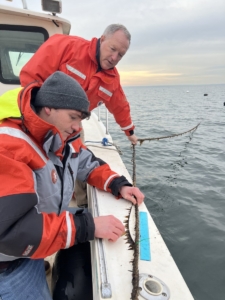
“I have been impressed by how my students – from core level to AP– all get excited by getting out of the classroom and learning on Long Island Sound. Whether it’s on the Schooner or at the Harbor Center, they are doing science they’ve never tried before and they’re enjoying it.”
– Aimee Reutzel, Teacher, AP Environmental Science and AP Biology, Danbury High School, Danbury CT
Middle School Science Experience
Real Science. Real Research. On Long Island Sound.
Bring science to life aboard the R/V Brewer, SoundWaters state-of-the-art research vessel. Students become marine scientists for the day, using professional research equipment to collect data, investigate marine ecosystems, and explore the environmental challenges facing Long Island Sound.
Watershed Expedition
A Hands-On Marine Science Adventure for Middle School Students.
Students will explore the Long Island Sound Watershed from the water and discover how our communities connect to the Sound’s health. Using scientific equipment, students will collect and analyze water samples, investigate water quality, and examine microscopic organisms that serve as indicators of ecosystem health. Through hands-on benthic trawling, students will discover and identify marine life living beneath the surface. Students will leave with practical marine research experience, a deeper understanding of the Sound’s ecosystem, and an appreciation for their role in protecting the Long Island Sound Watershed.
ACTIVITIES
Overview of Activities:
Water Quality Analysis
Students will help deploy a 6-bottle rosette sampler. This type of array models real in-field and on-board scientific research. Students will see temperature and conductivity gradients in real time. Students will conduct several tests, including temperature, salinity, CO2, NO3, and turbidity. Students will gain an understanding of different water quality parameters and how these parameters come together to create a clearer picture for environmental monitoring.
Benthic Trawl
Students will conduct trawls aboard the R/V to count and measure animals that come on board. The unique relations of animals in Long Island Sound to climate change, thermal tolerance, and redistribution will be discussed. Students can perform fish tagging while on board to deepen the learning and value of the trawl. The tagging and monitoring protocol will be discussed to deepen understanding of conservation principles.
Plankton Sampling
Students will conduct plankton analysis aboard R/V Brewer. A manta trawl net will be towed behind the boat, capturing samples that students will then analyze. If we use handheld plankton nets for a more interactive experience, students will lower these small nets over the R/V railing. The samples will be brought into the wet lab and students will observe and identify plankton captured in the net, discovering which species of phyto- and zoo-plankton are observed in the surface waters of Long Island Sound, and in what abundance. Students will also visualize plankton using a larger screen connected to a microscope.
NGSS ALIGNMENT
SCHEDULE
PRICING
NEXT STEPS
“I have been impressed by how my students – from core level to AP– all get excited by getting out of the classroom and learning on Long Island Sound. Whether it’s on the Schooner or at the Harbor Center, they are doing science they’ve never tried before and they’re enjoying it.”
– Aimee Reutzel, Teacher, AP Environmental Science and AP Biology, Danbury High School, Danbury CT
Want to learn more? Check out the FAQ.
Is the R/V Brewer for all ages?
The R/V Brewer is designed and outfitted to teach upper-level science, primarily to middle and high school students and college students. The vessel’s deck layout is not ideally suited for elementary students. The Schooner SoundWaters is an ideal learning experience for elementary school students.
What is the capacity of the R/V Brewer?
The R/V Brewer can accommodate 30 passengers. This includes all students, teachers, and chaperones.
Where do we board the R/V Brewer?
To minimize travel time for schools, the R/V Brewer is designed to access most coastal communities on Long Island Sound. Your school should be able to meet the vessel at the coastal community closest to your school.
What is the itinerary for our trip?
NEED A SAMPLE ITINERARY FOR AN R/V TRIP.
What will you teach on the new vessel?
In an era of a changing climate and the growing problem of microplastics, we have the ideal classroom in Long Island Sound to help students understand the science behind these very big subjects that will impact their futures. Students will use sophisticated equipment to collect and test water quality and compare it to historical data to see the changes over time. They will conduct trawls to bring up animals from the depths to learn their anatomy and the characteristics that make them uniquely adaptable or threatened by changing conditions. The on-board curriculum will align with State science standards to amplify classroom learning and create a rich and memorable educational environment.
What is the cost to bring my students on the R/V Brewer?
The cost to SoundWaters of a two-hour trip is $2,000. Thanks to SoundWaters donors, every school will receive an automatic $500 credit towards their trip. We recognize that school budgets vary and we are committed to making learning on the R/V Brewer accessible for all schools so further financial aid is available to schools based on need. Contact SoundWaters Director of Education, Christina Genz, at cgenz@soundwaters.org to discuss your school’s eligibility for financial aid.
$2,000 SoundWaters cost for a two-hour trip on the R/V Brewer
$1,500 Full cost to schools for a two-hour education sail
$1,125 Cost to schools with 25% of students on free/reduced lunch
$750 Cost to schools with 50% of students on free/reduced lunch
$150 Cost to schools with 75% or more students on free/reduced lunch
How do I get my students onboard?
If you are a teacher and want your students to learn on Long Island Sound on the R/V Brewer, we want to talk with you. Complete the form below and we will can start a conversation. The new vessel will be on the water mid-2027 and we expect available dates to fill quickly so the sooner you contact us, the better the chances you and your students will be aboard.
What happens in the event of poor weather or rough seas?
All programs are rain or shine, unless severe weather conditions are expected. R/V Brewer hosts heated and air-conditioned indoor lab space, and partial cover on the aft deck for wet conditions.
How far in advance should I book a trip for my class on the R/V Brewer?
Trips are scheduled on a first-come, first-served basis. School trips will begin in September 2027. Fill out the form below to learn more
Are there restrooms and shelter on board?
R/V Brewer is equipped with an enclosed, climate-controlled lab space and bathroom.
Do students need prior boating experience to participate?
No prior experience is required! Vessel crew and educators provide a comprehensive safety briefing before leaving the dock, and life jackets will be worn on board.
What should students wear/bring on board?
Layered clothing (it is often significantly cooler and windier on the water than on shore), a windproof or rainproof outer shell, closed-toe non-slip shoes, sun protection (sunscreen, sunglasses, hat), and a reusable water bottle.
Want to get your students on-board? Start Here.
What They’re Saying
“SoundWaters was my first serious exposure to the environment and Long Island Sound. When I look back and wonder why I care about the environment, it’s because of SoundWaters.That experience planted a seed of environmental stewardship.”
– Aaron Hilliard,
SoundWaters Alumnus,
Firefighter, Hackensack, NJ