
What are salt marshes?
If you’ve ever had the chance to explore Cove Island Park, you have probably come across swaths of tall grasses swaying with the wind along the
coastline. The sun peeking through the long blades of grass makes for a gorgeous view along the water during your morning walk from late spring through the fall. These are salt marshes! Salt marshes are not only beautiful, but they are also crucial to the environment.
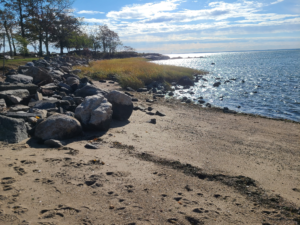
Salt marsh grasses are flooded twice a day, as the tide comes in and out. Here in Long Island Sound, salt marshes live in brackish water. Native plants include Spartina alterniflora (smooth cordgrass), Spartina patens (salt meadow cordgrass), Spartina cynosuroides (big cordgrass), and Distichlis spicata (spike grass). With deep roots, these grasses grow in a thick layer of peat. Near the base of the grass, you can also find mussels buried in the peat, giving them a solid foundation to withstand the changing tides.
Why are they important?
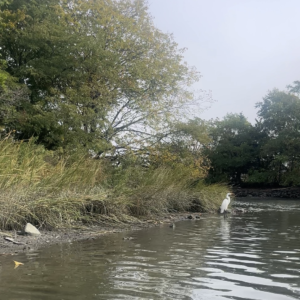
Thriving with life, these coastal wetlands are home to many species, including mollusks, crustaceans, fish, and the only species of turtle in North America that lives exclusively in brackish water, the Diamondback Terrapin. Salt marshes play a vital role in providing food and shelter for the animals of the Long Island Sound. Migratory birds also rely on the marshes for food and shelter, allowing them a restful break during their long migration journey.
This amazing habitat is not only home to many different species, but it also plays a crucial role in Long Island Sound’s water quality. While salt marshes don’t always smell the best, they play a key role in filtering runoff and absorbing excess nutrients from the water. Salt marshes act as a “carbon sink”, holding excess carbon. Without this, excess carbon would leak into our water, increasing the effects of climate change.
Furthermore, when storms hit the coastline, they cause large tidal wave activity and flooding. These patches of habitat provide an important buffer between land and sea. The peat layer in the marsh acts like a sponge, absorbing high levels of water, keeping our infrastructure from flooding during high storms.
How do rising sea levels affect these habitats?
Over the years, millions of people have come to know Long Island Sound as their home, living up and down the Atlantic Coast. For this reason, many of the salt marshes were destroyed to accommodate the growth of our cities along the coastline. Now, as sea levels continue to rise, surviving patches of salt marsh are facing a new threat.
With higher water levels, salt marsh grasses are being exposed to a larger amount of salt, causing a loss in plant diversity. Plants that are less salt-tolerant won’t survive. Additionally, higher tides are washing out larger amounts of sediment, eroding the foundation necessary for these grasses to take root.
Since the 1800s, Connecticut and Long Island have lost over 7,000 acres of coastal wetlands, more than one-third of these crucial ecosystems. Globally, numbers are as high as 800 million acres, 21% of our total coastal wetlands.
Don’t lose hope, there is more we can do!
In 1969, the Connecticut Tidal Wetlands Act and the Connecticut Coastal Management Act in 1980 were passed, protecting wetlands from ruination. Efforts to save these coastal wetlands have been successful and prove that humans can work in tandem with the marshes’ natural resiliency. In locations where there is enough undeveloped land, marshes have begun moving further inland to withstand the rising sea levels. There have been many efforts to help protect undeveloped land, allowing the space for these grasses to continue to grow. Many organizations such as the Coastal Restoration Coalition, which includes SoundWaters, bring together different organizations in New York and Connecticut to take part in restoring Long Island Sound’s salt marshes.
Here at SoundWaters, high schoolers are engaged in initiatives to grow, plant, and restore these grasses. You too can help by getting involved with restoration events and making daily choices that keep the health of the salt marsh and global environment in mind! Our salt marshes are not only beautiful to enjoy on your morning walk, but crucial to our community’s health and safety.
Citations:
https://www.doi.gov/sites/default/files/salt-marsh-fact-sheet.pdf
https://www.nerra.org/impact/science/marsh-response-to-sea-level-rise/
https://menunkatuck.org/marsh-migration-survey
https://portal.ct.gov/deep/coastal-resources/living-on-the-shore-brochure/tidal-wetlands


